00 / ABSTRACT
The NFT is the key.
The Chamber is the agent.
QUORUMBORN combines an ERC-721 collection capped at 3,333 with deterministic ERC-6551 accounts, onchain Passports, one-NFT-one-vote governance, timelocked execution, consensus-triggered VERDICT issuance, ERC-1155 Relics, holder-gated Assembly Chat, and a deployed but paused Autopilot architecture.
The system is designed to move collection utility away from private databases and discretionary promises. Core identity, voting, proposal state, reward issuance, Chamber derivation, asset custody, and execution paths are represented by deployed smart contracts on Robinhood Chain Mainnet.
The live portal connects these contracts to holder setup, Passport inspection and sharing, and My Chamber: receive ETH, check a Chamber's balance, and send ETH back to the current NFT owner's wallet. An interactive preview uses sample balances without a wallet connection. Aggregate website measurement evaluates onboarding without linking visitors to wallets or OpenSea purchases.
PROTOCOL PRINCIPLE Consensus is not a promise. It is an execution path.
01 / PROTOCOL THESIS
From collectible
to coordinated identity.
Image + ownership
A conventional NFT identifies an owner and points to media, while most utility remains elsewhere.
Identity + account + action
The token anchors an account, participates in governance, receives protocol assets, and can execute owner-authorized calls.
02 / IDENTITY LAYER
A fixed Assembly
with transparent terms.
Hard-coded maximum supply.
Maximum reserve minted to treasury.
Maximum available through the public drop.
Configured OpenSea public stage.
Maximum configured per wallet.
Collection-level creator earnings setting.
The administrator can permanently close minting before the cap is reached. If that occurs, governance and reward calculations use the smaller finalized supply. Closing is irreversible in the collection contract.
The visual collection is built from 32 separate species sources with weighted rarity. PNG artwork and JSON metadata are stored through IPFS-oriented URIs rather than generated as onchain SVG. Visual rarity does not change governance weight or consensus reward rate: each existing NFT is one voting unit and one reward unit.
03 / TOKEN-BOUND CHAMBERS
Every identity has
a deterministic account.
A Chamber is an ERC-6551-style account bound to a specific QUORUMBORN token ID. Its address is derived from the registry, account implementation, collection, chain, token ID, and fixed Chamber salt.
- DeterministicThe address can be calculated before account deployment.
- Ownership-awareControl follows the current owner of the bound NFT.
- Asset-capableReceives ETH, ERC-721, ERC-1155, and compatible token assets.
- ExecutableThe NFT owner can make single or batched contract calls.
- Signature-readySupports ERC-1271 validation for smart-account signatures.
- Self-custody guardThe bound NFT cannot be transferred into its own Chamber.
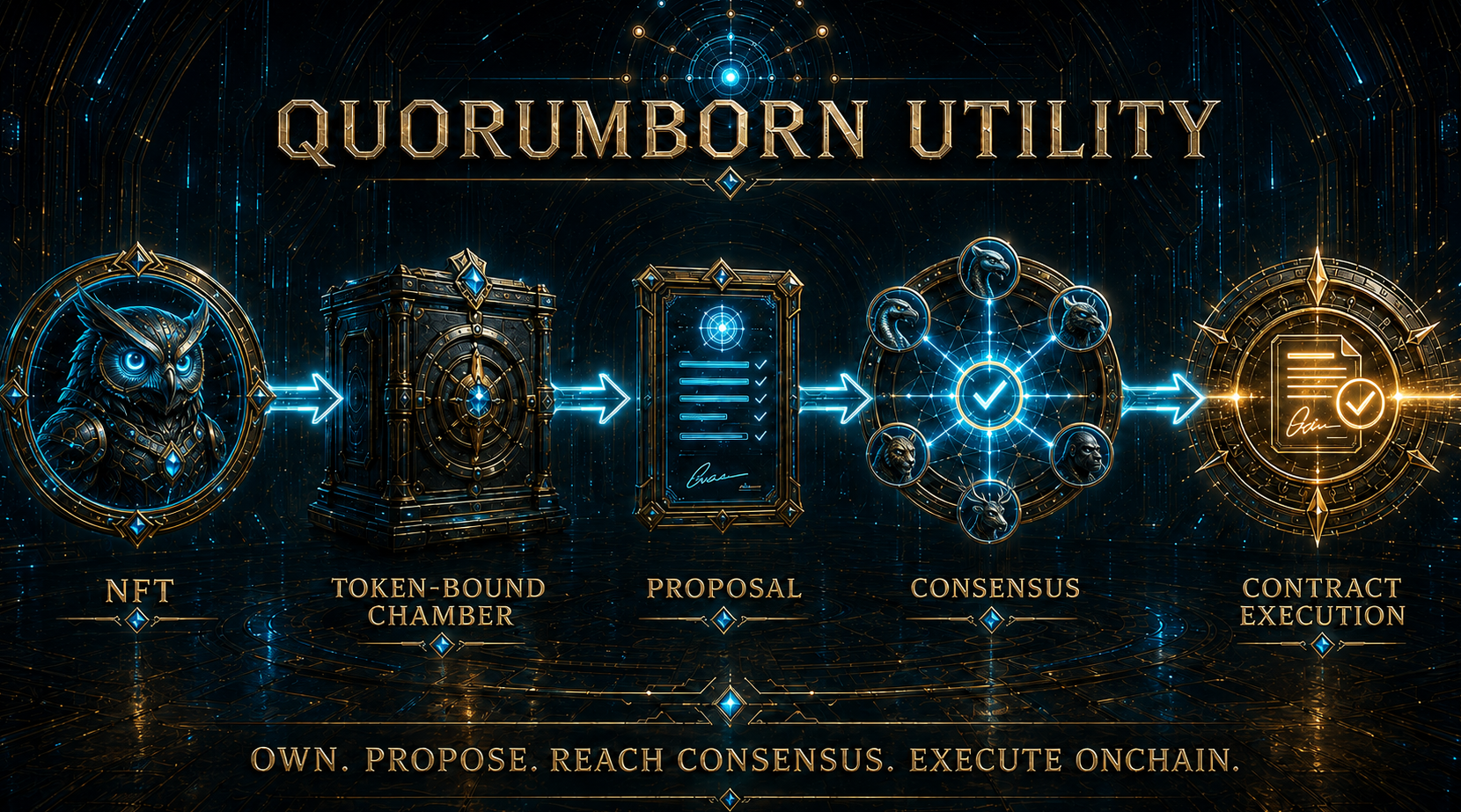
Transferring the NFT transfers control of its Chamber. Assets already held by that Chamber do not automatically leave it.
04 / PASSPORT AND HOLDER SETUP
A beginning recorded.
A history that follows.
The ChamberPassportRegistry stores participation against the NFT's token ID. Its history, score, and achievements follow the NFT across transfers. A Passport records the identity's activity; it is not proof of the current holder's personal history or a separate transferable token.
Select your identity
Mint on OpenSea, connect your wallet, and select an owned QUORUMBORN in holder setup on Robinhood Chain.
Passport + Chamber
Review the network fee and approve one transaction to initialize the Passport and deploy its deterministic Chamber if needed. Activation has no protocol payment; the submitting wallet pays gas.
Open your Chamber
Use My Chamber, inspect and share your Passport card, explore the Assembly Map, or enter holder-gated Assembly Chat.
First activation records Genesis Identity and one point once. With no other recorded activity, the identity remains at rank 0, shown as Dormant. Receiving or sending ETH does not award Passport points.
The underlying activation function is permissionless for an existing token. Activating another person's NFT gives the caller no control over its Chamber, and repeated activation does not award the first achievement again. Governance facts require explicit synchronization transactions; they are not automatically recorded by every Governor action.
| First activation | 1 point / Genesis Identity |
|---|---|
| Canonical vote synchronized | 5 points / once per proposal and token |
| Successful consensus participation synchronized | 10 points / once per eligible proposal and token |
| Canonical proposal synchronized | 20 points / proposal's originating NFT |
| Executed proposal synchronized | 30 points / proposal's originating NFT |
Governance participation becomes available after permanent mint finalization. Passport score does not change voting weight or VERDICT reward entitlement.
Assembly Seasons
The deployed AssemblySeasonManager supports named seasons, time windows, and a published Merkle eligibility root. During an enabled claim window, the current NFT owner can submit a proof and claim once per token ID per season. Claims record configured Passport score and achievements; this contract does not distribute ETH, VERDICT, or Relics.
Passport and Seasons are owned by the Protocol Timelock. Season creation, configuration, and exceptional achievement grants require their authorized control paths. Deployment of the manager does not mean a season is open or claims are available.
05 / MY CHAMBER / LIVE
Your NFT.
Its own wallet.
My Chamber is the holder interface for the selected NFT's canonical account on Robinhood Chain Mainnet. Before enabling withdrawals, it checks the network, current NFT ownership, account deployment, and token binding.
Address + QR
Copy the full Chamber address or use its locally generated receive QR, which includes the address and chain ID 4663.
Balance + fee
Read the native ETH balance, enter an exact amount, and review the recipient and estimated network fee before approving in your wallet.
Back to the owner
Withdraw native ETH to the connected current NFT owner's wallet through the Chamber's existing owner-authorized execution function.
Gas is paid separately from the Chamber's balance. You can withdraw its full native ETH balance when your connected wallet has enough ETH for the network fee. Estimates may change before confirmation.
The interface tracks pending transactions and checks mined details and receipts before reporting success. Rejected, failed, cancelled, replaced, or unresolved transactions do not trigger an automatic resend. Recent native ETH activity includes failed attempts and explorer links; indexed results may be delayed or incomplete.
The current interface supports ETH withdrawals to the connected owner. It does not expose arbitrary recipient, ERC-20, NFT-transfer, or general contract-call controls. The underlying Chamber's broader capabilities remain described in the Chambers chapter.
Try the interactive preview
The preview illustrates receiving ETH, reviewing a send, and seeing the result using clearly labelled sample balances and activity. No wallet is needed and no transaction is sent. Its sample Passport stays at one point; the preview does not change any real Passport or move funds.
My Chamber's live receive and owner-withdrawal controls are separate from paused Autopilot strategy execution. They do not activate trading or grant Autopilot spending authority. Transferring the NFT transfers control of its Chamber and any assets left inside it.
06 / ASSEMBLY GOVERNANCE
One NFT.
One vote.
Governance is based on QUORUMBORN ownership, not VERDICT balances and not visual rarity. A holder proposes with one owned token and votes with each owned token that has not already voted on that proposal.
Propose
The proposer supplies a target, value, calldata, description, and an owned token ID.
Delay
The proposal remains pending for the configured voting-delay block interval.
Vote
Each token may cast one yes or no vote during the voting period.
Finalize
Quorum and approval thresholds determine whether consensus succeeded.
Queue
A successful action is scheduled through the Protocol Timelock.
Execute
After the delay, any account may execute the ready timelocked operation.
| Governance activation | Only after minting is permanently finalized |
|---|---|
| Voting model | One existing QUORUMBORN NFT, one vote |
| Quorum | 20% of the proposal's snapshot supply |
| Approval threshold | 60% of participating votes |
| Voting delay | 864,000 blocks |
| Voting period | 6,048,000 blocks |
| Consensus cooldown | 6,048,000 blocks between successful finalizations |
| Execution delay | 172,800 seconds / 48 hours |
| Proposal bond | 0 while VERDICT supply is zero; currently 100 VERDICT afterward |
Block-based periods should be interpreted using the live chain's block cadence. Passed and timely cancelled proposal bonds are returned; defeated proposal bonds are transferred to the configured treasury.
07 / VERDICT PROTOCOL TOKEN
No consensus.
No emission.
$VERDICT
An ERC-20 protocol token minted by the ConsensusRewards contract under Assembly control.
A successful proposal finalization opens a reward epoch. ConsensusRewards mints the lesser of the configured reward and the remaining cap headroom, updates a cumulative reward index, and permits each token ID's accrued amount to be claimed into its deterministic Chamber. Anyone may trigger a claim, but the assets are delivered to the Chamber controlled by the NFT's current owner.
The 100 million limit is a maximum outstanding supply, not an irreversible lifetime-mint counter. VERDICT is burnable, and burned tokens restore minting headroom under the deployed cap check.
VERDICT does not determine voting power in the deployed Governor. No staking contract, liquidity program, exchange listing, market value, or guaranteed yield is part of the deployed protocol described by this paper. Any future staking system would require a separate design, deployment, security review, and governance decision.
08 / RELICS, REVEAL, AND MEDIA
Utility delivered
to the identity.
ERC-1155 inventory
The Timelock-owned Relic contract can configure IPFS metadata and mint item balances directly into a token's Chamber.
Commit + future block
A committed secret combines with a future Robinhood Chain block hash. Finalization is permissionless during the valid window.
PNG + IPFS metadata
The collection uses raster PNG artwork and JSON metadata referenced through IPFS-oriented URIs, not onchain SVG.
The reveal coordinator owner schedules the reveal using the precommitted secret. If the 256-block blockhash window expires, anyone may reschedule without changing the commitment. Metadata IDs are offset using the final seed.
09 / ASSEMBLY CHAT
Holder access.
Verified at the door.
Free wallet signature
Signing creates no transaction and requests no spending authority. Live NFT ownership is checked directly on Robinhood Chain.
Assembly Commons
Verified holders can read and post with live updates, profiles, reporting, moderation, mutes, and bans.
Communication, not voting
Chat messages and moderation are offchain. They do not create proposals, cast votes, establish consensus, or execute contracts.
Assembly Chat uses signed web sessions and repeated ownership checks. Its messages, profiles, and moderation records are isolated application data, separate from Signal Saints and separate from onchain governance.
10 / WEBSITE MEASUREMENT AND PRIVACY
Measure onboarding.
Keep the limits visible.
The live portal counts page views, OpenSea mint-link clicks, and activation and withdrawal confirmations observed by the holder interface. Counts are grouped by UTC day and fixed source categories: direct, X, Discord, Telegram, OpenSea, search, or other. Reports are private and use no external analytics service.
Aggregate events
The collector does not persist wallet addresses, token IDs, transaction hashes, amounts, balances, raw IP addresses, full page or referrer URLs, or persistent visitor identifiers.
Its browser helper uses no analytics cookies or local storage and honors Do Not Track and Global Privacy Control. It does not follow visitors across pages, devices, wallets, or purchases.
Independent chain totals
Read-only chain reporting measures actual public mint totals and first Passport activations separately. Public mints are lifetime total mints minus reserve mints; circulating supply is reported separately.
Browser events can be missed, repeated, or spoofed. Page views are not unique people, and mint-link clicks are not completed purchases. These counts do not establish verified visitor conversion rates or campaign purchase attribution.
Reports cover the latest 90 UTC days; expired days are removed on the next accepted aggregate write. Brief in-memory rate limits reduce abuse. Existing web-server logs, wallet interactions, pending-transaction recovery, and holder-chat sessions are separate systems. No withdrawal values or investment returns are measured.
11 / CHAMBER AUTOPILOT
Deployed architecture.
Execution paused.
Chamber Autopilot is a non-custodial strategy-execution architecture designed to keep each holder's configuration and assets isolated inside that NFT's Chamber rather than in pooled custody.
Strategy controls
Defines holder-configured amounts, triggers, cooldowns, daily limits, and execution gates.
Restricted routing
Provides a constrained V2-style spot swap path intended to return resulting assets to the originating Chamber.
Price protection
Provides the WETH/USDG ratio guard used for freshness checks and minimum-output protection.
Autopilot is not active and strategy execution is unavailable. Holders should not deposit or approve assets for Autopilot use. Activation requires completed testing, integration and permission review, an independent audit, and an authorized onchain action.
No return, profit, availability, liquidity, or execution outcome is promised. Autopilot adds oracle, routing, slippage, liquidity, token, smart-contract, and configuration risks if it is activated in the future.
12 / CONTROL AND SECURITY
Authority should be
visible, not implied.
Collection operations
Owns the collection and reveal coordinator, controls permitted inherited collection settings, may permanently close minting, and schedules the reveal.
Economic utilities
Owns VERDICT, ConsensusRewards, RelicItemsIPFS, ChamberPassportRegistry, AssemblySeasonManager, and the Autopilot control path. Authorized changes pass through delayed execution.
Proposal execution
Holds Timelock proposer and canceller roles. Successful proposals queue executable calls and open consensus reward epochs.
Ready operations
The Timelock executor role is open, allowing any account to execute an operation after its required delay has elapsed.
Source verification proves that published source corresponds to deployed bytecode; it is not a security audit. The manifests record exact-match Sourcify verification for the original nine core contracts and the two Passport and Seasons contracts. The three Autopilot addresses are publicly disclosed. This document does not represent that an independent professional Autopilot audit has been completed. Users should review the contracts, permissions, dependencies, and chain assumptions before committing material value.
13 / MAINNET DEPLOYMENTS
Fourteen contracts.
One execution graph.
These fourteen project deployments exclude the external SeaDrop minting dependency. My Chamber uses existing contracts and adds no new custody contract.
14 / PROTOCOL ROADMAP
Deployed first.
Expanded deliberately.
Identity infrastructure
Collection, Chambers, Registry, Governor, Timelock, VERDICT, rewards, reveal, Relics, OpenSea drop, and public portal deployed.
Public Assembly
Public mint, species storytelling, and contract education continue. Live features include holder setup, Passport activation and sharing, the Assembly Map, My Chamber ETH receiving and owner withdrawals, recent activity, the interactive preview, holder-gated Assembly Chat, and aggregate website measurement. Passport and Seasons contracts are deployed; individual seasons require authorized configuration before claims can open.
Governance activation
Minting closes permanently, reveal completes, proposals begin, and successful consensus can open VERDICT reward epochs.
Autopilot review
Autopilot contracts are disclosed while testing, integration review, and independent audit remain pending. Strategy execution is inactive.
Chamber extensions
Season programs, potential Autopilot activation, Relic programs, protocol integrations, and separately deployed staking may be considered through security review and governance.
Roadmap items beyond deployed functionality are intentions, not guarantees, and may change through technical, legal, security, or governance review.
This edition adds the live Passport and My Chamber experience, the sample preview, measurement and attribution limits, and Passport and Seasons deployments. Governance still requires permanent mint finalization; Autopilot remains deployed and paused.
15 / RISKS AND DISCLOSURES
Read the system
before entering it.
Smart-contract risk
Verified source can still contain defects. Contract interactions may be irreversible and assets held by Chambers may be exposed to implementation or integration risk.
Administrative risk
The collection and reveal coordinator retain administrator-controlled functions. Timelock-governed components remain changeable through authorized proposal execution.
Network and dependency risk
The protocol depends on Robinhood Chain, RPC access, SeaDrop behavior, marketplace indexing, wallet software, IPFS availability, and integrated token contracts.
Economic risk
NFTs and VERDICT may have no market, liquidity, or value. Royalties may not be enforced by every venue. Gas, prices, and marketplace terms may change.
Governance risk
Low participation, concentrated NFT ownership, proposal design, voting incentives, and executable calldata can produce outcomes individual holders oppose.
Legal and tax risk
Laws and tax treatment differ by jurisdiction and may change. Participants are responsible for obtaining independent professional advice.
Chat and platform risk
Assembly Chat is offchain and depends on web-service availability, RPC access, session security, storage, and moderation. Chat statements are not governance actions.
Autopilot risk
Autopilot is paused and unaudited. Any future activation would add oracle, routing, slippage, liquidity, integration, and strategy-configuration risks.
Chamber and Passport use
Wallet, RPC, and explorer availability affect the interface; balances and activity can lag. Check pending or replaced transactions before retrying. Failed transactions can still cost gas. Transferring the NFT transfers control of remaining Chamber assets. Passport points do not certify a person's trustworthiness or promise future rewards; sample preview outcomes do not predict real transaction results.
NO EQUITY. NO GUARANTEED RETURN.
A QUORUMBORN NFT does not represent shares, ownership, debt, profit rights, or equity in a company or legal entity. VERDICT is described as a protocol token and is not a promise of profit, listing, liquidity, redemption, or future value. Nothing in this paper is investment, legal, tax, or financial advice, or an offer where such an offer would be unlawful.
THE ASSEMBLY IS OPEN